Trump’s Immigration Crackdown Triggers 80% Immigrant Job Drop, Goldman Warns
A comprehensive immigration enforcement initiative during President Donald Trump’s second administration, featuring heightened deportation activities and stringent new restrictions on visas, has triggered an 80% reduction in net immigration flows into the United States, as detailed in a fresh evaluation from Goldman Sachs. This analysis, published on February 16, cautions that the sharp decrease in incoming foreign-born laborers is profoundly transforming the dynamics of the country’s labor supply and reducing the number of new jobs required each month to preserve economic equilibrium.
Redefining the ‘Break-Even’ Number for Job Growth
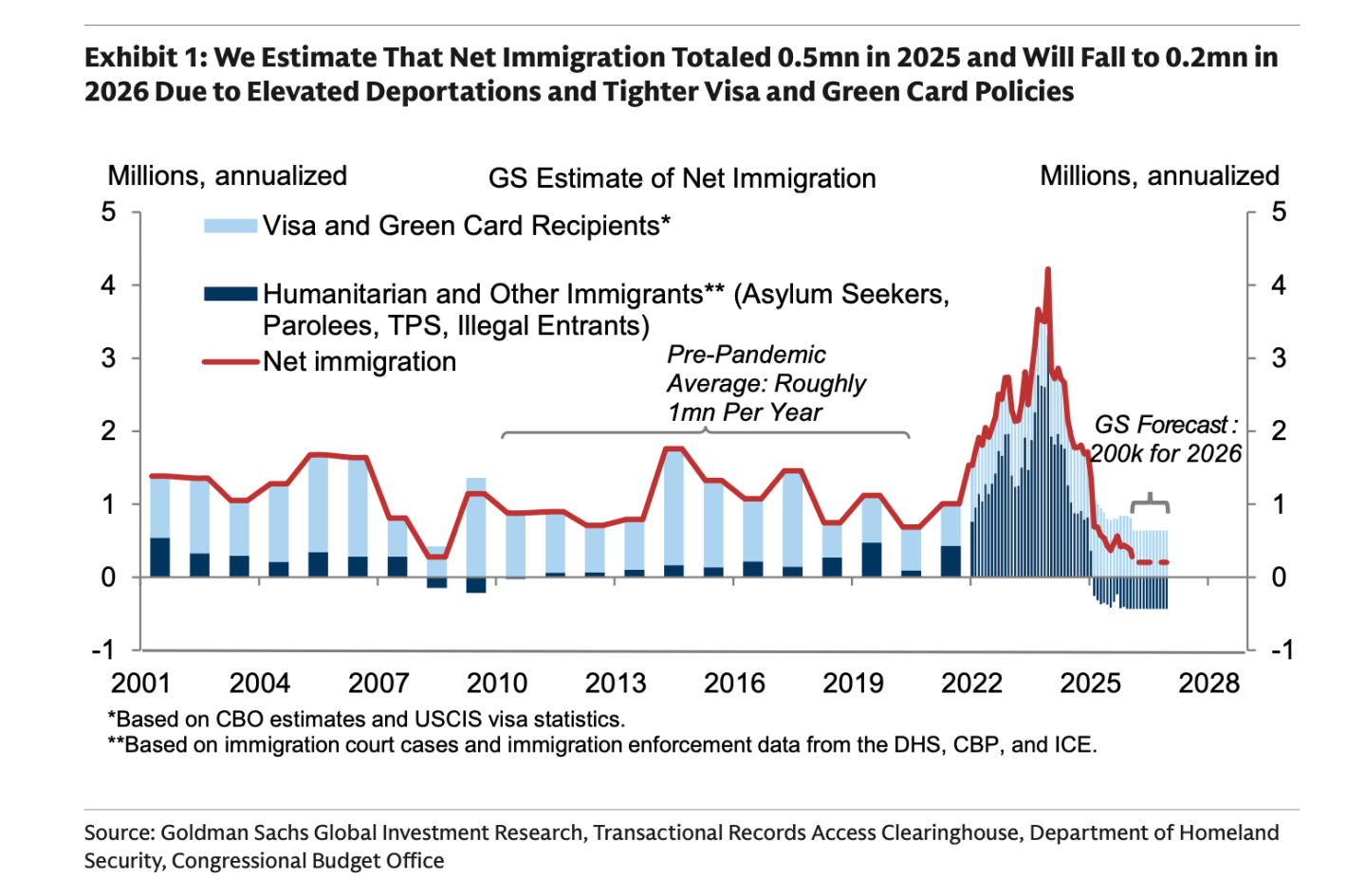
The U.S. economics team at the investment bank, under the guidance of David Mericle, forecasts a dramatic decline in the influx of new employees. During the 2010s, net immigration typically hovered around 1 million individuals annually, but this number dropped to 500,000 in 2025 and is expected to sink even lower to only 200,000 in 2026, according to Goldman Sachs projections. This marks an 80% decrease compared to the long-term average, a change the analysts directly connect to bold policy shifts such as increased deportation efforts, a newly implemented halt on processing immigrant visas from 75 nations, and an broadened travel ban.
Experts point out that these actions are poised to substantially hinder the entry of visa holders and green card recipients, while the revocation of Temporary Protected Status for nationals from certain countries introduces additional pressures on the availability of workers. The analysis clearly ties the anticipated reduction to ramped-up deportations alongside more restrictive policies on visas and permanent residency applications.
This intense limitation on the stream of available labor is compelling economic analysts to adjust their standard metrics for assessing the health of the U.S. economy. With fewer immigrants arriving, the labor force expands more slowly, meaning the economy can sustain a steady unemployment rate with far fewer additional positions created each month. According to Goldman Sachs, this so-called break-even rate for job additions is set to decrease from the present 70,000 per month to a mere 50,000 by the close of 2026.
The team led by Mericle observed that labor supply expansion has contracted markedly since immigration levels peaked in late 2023. As a result, monthly employment reports that would have appeared underwhelming in prior periods may now indicate a balanced situation. A modest increase in hiring would suffice to match the reduced pace of labor force growth needed for stability, the researchers explained, noting that the diminished worker pool is concealing potentially tepid demand for new hires.
The absence of these workers has ignited substantial discussions—and even concerns—among economists, as the drop in immigration adds another layer of complexity to economic indicators. This comes alongside other variables like the diminishing effects of Trump’s tariff policies, often likened to a shrinking ice cube, and ongoing debates about whether artificial intelligence represents a genuine boom or merely a speculative bubble.
Some observers, including prominent Stanford economist Erik Brynjolfsson, interpret the rising productivity per worker as evidence of an impending surge driven by AI technologies. Conversely, others view this as a pivotal juncture where large corporations might apply to office-based roles the same downsizing strategies once used on manufacturing jobs during the 1990s. Goldman’s findings imply that the economy is adapting to operate effectively without the vital contributions from immigrant labor that supported previous growth phases. Notably, Mericle’s report carries the title Early Steps Toward Labor Market Stabilization, underscoring this adaptation.
Additional forecasts from fellow economists align with this perspective. For instance, Michael Pearce from Oxford Economics has suggested the economy is approaching a break-even threshold while generating fewer jobs overall. In August of the previous year, David Kelly, a strategist at J.P. Morgan Asset Management, anticipated the strong possibility of zero net growth in the workforce over the ensuing five years, attributed to shifts in U.S. immigration patterns combined with the aging of the domestic-born population.
Shadow Workforce and Broader Economic Risks
Beyond the visible impacts, the intensified immigration controls could be driving segments of the labor market underground, according to Mericle’s assessment. The report posits that stricter enforcement measures encourage immigrant workers to transition into positions not reflected in official government statistics, which could distort key data sets. Such distortions hinder the Federal Reserve’s capacity to accurately assess the economy’s condition, since formal payroll figures might overlook substantial portions of actual employment trends.
This phenomenon could account for the apparent steadiness in the headline unemployment rate, which has held around 4.3% and recently touched 4.28%. Nevertheless, Goldman Sachs describes the labor market as inherently unstable due to these uncertain elements. The analysis points to a significant reduction in technology sector jobs, though it emphasizes that tech represents only a minor fraction of total employment. Of greater worry is the persistent downward trend in job vacancies, which have now dipped below pre-pandemic figures to approximately 7 million openings.
In another publication, Goldman Sachs’ chief economist Jan Hatzius assigned a 20% likelihood of a moderate recession within the coming 12 months. The firm anticipates labor market stabilization, with unemployment expected to edge up modestly to 4.5%. That said, they cautioned that downside risks predominate, stemming from subdued initial labor demand conditions and the prospect of accelerated, potentially disruptive rollout of artificial intelligence systems.
To elaborate further on the immigration policy shifts, the Goldman Sachs report meticulously outlines how specific measures are reshaping workforce dynamics. The elevated deportation rates, for one, directly reduce the number of available workers by removing individuals already integrated into various industries. This is compounded by the visa processing pause affecting 75 countries, which targets a broad spectrum of potential entrants, from skilled professionals to seasonal laborers, effectively choking off a major pipeline for talent and manual labor alike.
The expanded travel ban adds another layer, limiting entries from regions historically contributing significantly to U.S. immigration. Meanwhile, the loss of Temporary Protected Status not only affects immediate labor availability but also creates long-term uncertainties for affected communities, many of whom have been contributing to sectors like construction, agriculture, and hospitality for years.
Economists are particularly attentive to how these changes recalibrate the break-even job growth figure. In practical terms, this means that policymakers and businesses must interpret employment data through a new lens. A jobs report showing only 50,000 additions, which might have signaled weakness previously, now aligns with a stable labor market given the constrained supply. This shift could influence everything from Federal Reserve interest rate decisions to corporate hiring strategies.
The broader economic discourse is enriched by comparisons to historical precedents. The 1990s downsizing wave in manufacturing, driven by automation and globalization, offers a cautionary parallel for today’s white-collar sectors potentially facing AI-driven efficiencies. Yet, optimists like Brynjolfsson highlight how fewer workers paired with advanced tools could yield outsized productivity gains, potentially offsetting labor shortages.
Regarding the shadow economy, the implications extend to data reliability. Official statistics from the Bureau of Labor Statistics might undercount employment if workers evade formal channels due to enforcement fears. This underground shift could mask inflationary pressures or wage growth in certain niches, complicating monetary policy.
Goldman’s recession probability assessment incorporates these labor market nuances alongside fiscal and technological risks. The 20% figure reflects a balanced view: stabilization is plausible, but vulnerabilities abound. Hatzius’s note on AI deployment underscores a dual-edged sword—productivity booster or job displacer—amplifying the need for vigilant monitoring.
In summary, Trump’s immigration policies are not merely altering border flows; they are reengineering the foundational elements of U.S. economic growth. Businesses in labor-intensive industries may face acute shortages, prompting investments in automation or wage hikes to attract native workers. Meanwhile, the evolving break-even dynamics suggest a more resilient economy in some respects, albeit one shadowed by uncertainties and potential disruptions.