Tesla’s $20B+ Investment Signals Bold Autonomous Future
Tesla’s Revolutionary Transportation Vision Takes Center Stage
Although massive capital expenditures in artificial intelligence by tech giants such as Alphabet and Amazon have dominated investor discussions lately, Tesla’s dramatic escalation in spending stands out as potentially far more impactful for the transportation sector. The electric vehicle leader is gearing up to allocate more than $20 billion in capital expenditures throughout 2026, representing over double the amount expended in the prior year. This substantial financial commitment not only underscores the company’s aggressive growth strategy but also reveals a distinctive perspective on the future trajectory of mobility and vehicle usage.
What sets Tesla’s approach apart is its unwavering focus on transforming how people and goods move, prioritizing innovation over conventional automotive manufacturing. This strategic pivot is poised to reshape industry dynamics, positioning Tesla at the forefront of a new era in transportation.
Tesla’s Expansive Capital Investments Reshape the Landscape
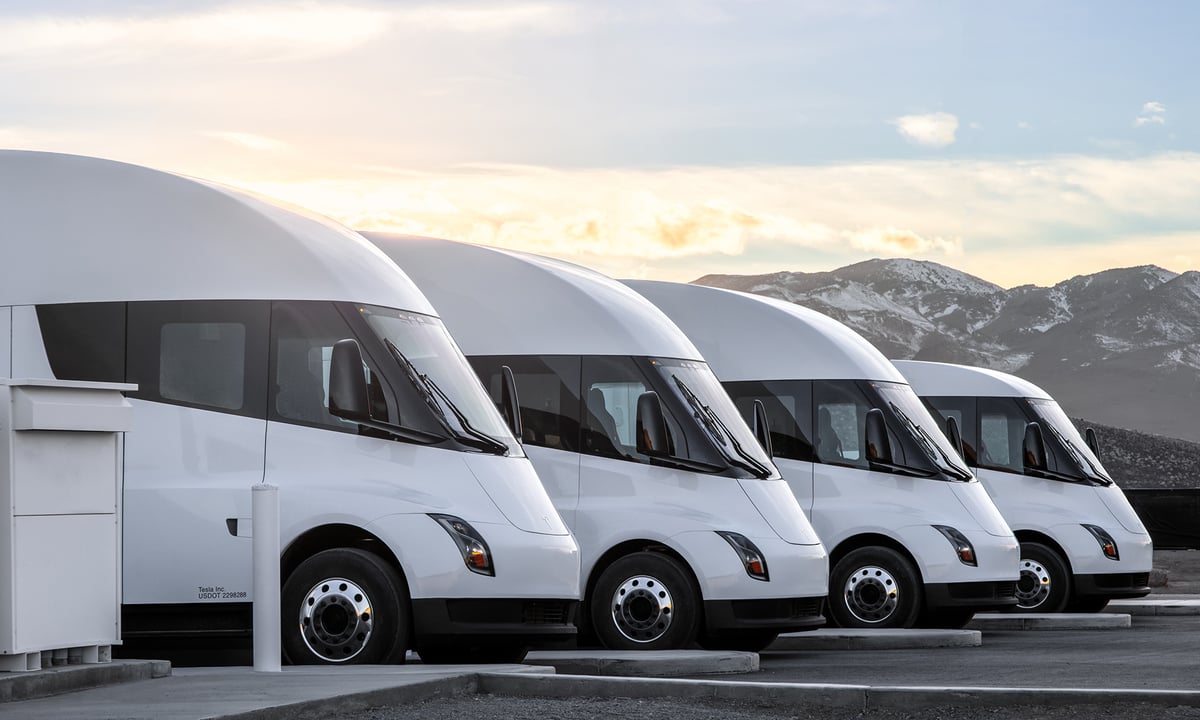
Tesla’s ambitious investment blueprint encompasses a diverse array of production facilities and infrastructure projects, signaling a multifaceted expansion. Notably, three out of the six planned factories will dedicate resources to manufacturing the Optimus humanoid robot, producing the Tesla Semi truck, and constructing a massive facility for battery energy storage systems. These initiatives highlight Tesla’s broadening ambitions beyond traditional vehicles into robotics and energy solutions.
Complementing these are the remaining three key investments: a state-of-the-art lithium refinery, a specialized factory for cost-effective lithium iron phosphate (LFP) batteries suited perfectly for affordable vehicle models and the upcoming Cybercab, and a dedicated production line for the Cybercab itself. These developments are expressly designed to bolster the continued expansion of Tesla’s electric vehicle lineup, ensuring scalability and cost competitiveness in passenger cars.
Unlike some rivals in the automotive space, including Ford, General Motors, and Stellantis, which have recently curtailed their electric vehicle initiatives to prioritize budget-friendly options amid market challenges, Tesla is doubling down on its comprehensive strategy. The company views autonomous transportation not as a sideline but as the cornerstone of tomorrow’s mobility ecosystem, integrating advanced self-driving capabilities seamlessly into its product portfolio.
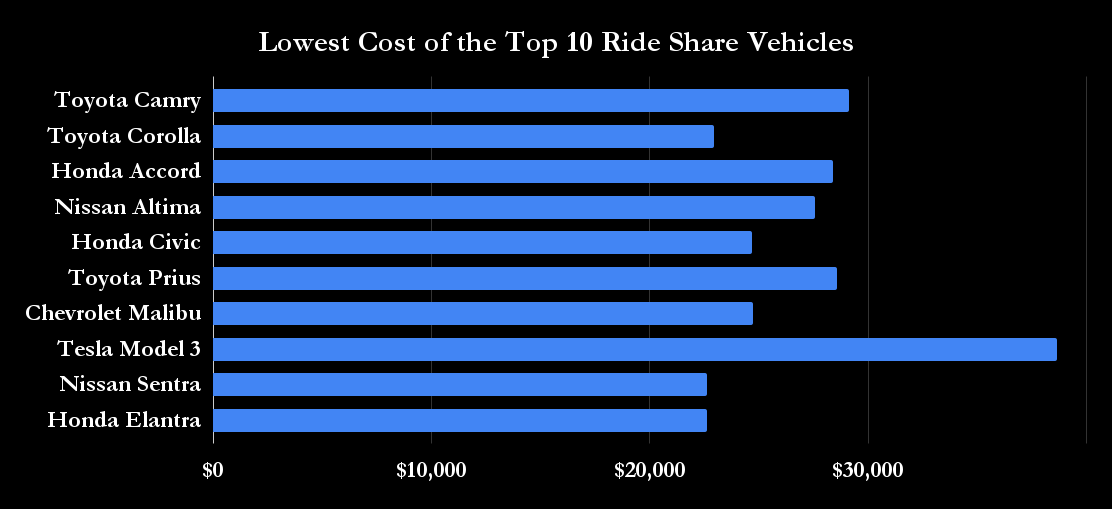
This data visualization from Insurify.com illustrates the top 10 vehicles most commonly utilized in ride-sharing services, ranked by cost efficiency. The Tesla Model 3 emerges as the priciest upfront purchase among them yet achieves remarkable savings on a per-mile basis, making it a favored option for drivers in this space. Such trends provide early validation of electric vehicles’ viability in high-utilization scenarios like ride-hailing.
Why Tesla is Poised for Dominance in Ride-Sharing
During the latest earnings conference call, Tesla’s CEO Elon Musk articulated a compelling forecast for the evolution of driving. He emphasized that in the coming years, fewer than 5% of total miles traveled might involve human drivers, potentially dipping as low as 1%. This projection stems from Tesla’s conviction that fully autonomous systems will supplant manual operation across the vast majority of journeys.
Rather than retreating from electric vehicles, Musk is steering Tesla directly toward this anticipated market shift. He confidently predicts that production of Cybercabs will eventually surpass that of all other Tesla models combined, reflecting the company’s strategic emphasis on robotaxi deployment as a primary revenue driver.
Realizing this ambitious roadmap hinges on several critical milestones: obtaining necessary regulatory clearances for robotaxi operations, unveiling the purpose-built Cybercab vehicle, and securing approvals for unsupervised full self-driving (FSD) software in commercial settings. Each step builds toward a network of autonomous vehicles capable of operating profitably without human intervention.
Evidence Supporting Tesla’s Robotaxi Supremacy
Emerging market data lends credence to Musk’s outlook on robotaxis dominating transportation. For instance, analysis from Insurify.com, a leading car insurance comparison platform, ranks the most prevalent vehicles in ride-sharing applications. The Tesla Model 3 tops the list not despite its higher initial cost but because of its superior operational economics, delivering the lowest cost per mile among popular choices—even when accounting for a human driver.
Extrapolating this further, the introduction of Cybercab promises even greater efficiencies. Priced below $30,000, this dedicated robotaxi will eliminate driver-related expenses, slashing per-mile costs dramatically compared to Model 3 taxis or traditional internal combustion engine vehicles with operators. This cost advantage could propel widespread adoption, especially in dense urban environments where ride-sharing demand is relentless.
Current adoption rates of Tesla vehicles in ride-hailing already outpace many competitors, demonstrating real-world proof of concept. Drivers appreciate the reliability, low maintenance, and energy efficiency, which translate to higher earnings potential. As autonomy matures, these vehicles will transition from driver-assisted to fully independent operations, unlocking exponential value.
Strategic Investments Fuel Cybercab Momentum
Tesla’s upstream investments in lithium refining directly support expanded battery production, which is essential for scaling Cybercab manufacturing. By controlling more of the supply chain, the company mitigates risks associated with raw material volatility and ensures a steady flow of components for high-volume output.
Moreover, the prevalence of Tesla EVs in taxi services today provides a strong foundation. Ride-share operators have gravitated toward these models for their performance and economics, setting the stage for a seamless upgrade to unsupervised autonomy. Should Tesla navigate regulatory hurdles successfully, the irrefutable per-mile cost superiority of robotaxis will solidify its vision for transportation dominance.
Assessing the Potential Outcomes of Tesla’s Monumental Wager
While success is not assured—given the complexities of regulation, technological refinement, and market acceptance—the rewards could be transformative. Tesla shareholders are increasingly optimistic, drawn by the enormous growth prospects embedded in this strategy. The company’s market capitalization reflects substantial investor confidence, yet analysts believe there’s considerable room for appreciation if key objectives are met.
Tesla’s integrated approach, spanning vehicle production, energy storage, autonomy software, and now humanoid robotics, positions it uniquely against fragmented competitors. Rivals scaling back EV commitments may cede ground, allowing Tesla to capture disproportionate market share in the autonomous era.
In summary, this unprecedented investment wave—exceeding $20 billion in 2026—crystallizes Tesla’s faith in a future where robotaxis, Cybercabs, and AI-driven mobility redefine transportation. By aligning capital deployment with a clear, differentiated vision, Tesla is not merely participating in industry evolution but actively engineering it, potentially delivering outsized returns for those who share its conviction.