Nvidia Faces Tough Challenge Meeting High Investor Hopes on Feb. 25
A classic “buy the rumor, sell the news” scenario could unfold once more in the stock market.
Over the past three years, artificial intelligence (AI) has dominated as the premier investment theme on Wall Street. Equipping software and systems to execute precise, instantaneous decisions independently of human input represents a transformative breakthrough, poised to generate trillions of dollars in worldwide economic benefits.
Numerous publicly listed firms are capitalizing on this AI surge, but Nvidia stands out as the ultimate embodiment of this technological advancement. From the close of 2022, Nvidia’s market capitalization has surged by almost $4.2 trillion, propelling it to the pinnacle as Wall Street’s most valuable enterprise.
It comes as little surprise, then, that Nvidia’s financial performance garners the utmost anticipation among all public companies. With the majority of earnings season now behind us, all eyes remain fixed on Nvidia, which plans to unveil its fiscal 2026 fourth-quarter results—covering the period ended January 25, 2026—right after the market closes on February 25.
Analysts anticipate Nvidia will continue its tradition of handily exceeding Wall Street’s collective projections for revenue and profitability. Nevertheless, various indicators point to potential struggles in aligning with the extraordinarily elevated hopes held by investors.
Demand for Nvidia’s AI hardware remains voraciously strong
As Nvidia prepares to disclose its fiscal fourth-quarter figures in just over a week, forecasters are projecting around $65.6 billion in revenue, reflecting a robust 67% increase compared to the previous year, alongside earnings per share (EPS) of $1.52. Given Nvidia’s track record of surpassing consensus EPS estimates by 3% to 8% across the prior four quarters, it seems highly probable that the company will once again vault over these benchmarks.
This consistent outperformance is largely fueled by the unrelenting appetite for Nvidia’s AI graphics processing units (GPUs). These powerful components serve as the core engines driving rapid decision-making processes, generative AI applications, and the training of large language models within high-speed, AI-enhanced data centers.
Nvidia’s flagship GPU lines—such as the Hopper (H100), Blackwell, and Blackwell Ultra—boast computational prowess that outstrips any rival offerings. Savvy enterprises aiming for a competitive advantage have consistently opted for Nvidia’s AI GPUs to equip their data centers.
Reinforcing this dominance, Nvidia’s CEO Jensen Huang has poured substantial resources into research and development initiatives. These efforts are designed to safeguard the company’s lead in computational performance. Nvidia is poised to launch a cutting-edge GPU annually, including the forthcoming Vera Rubin chip, which will leverage the innovative Vera processor and debut later this year. Rival firms are already finding it challenging to catch up with Nvidia’s earlier-generation products, suggesting that the reigning market leader faces minimal credible threats to its compute supremacy in the near term.
Moreover, Nvidia continues to capitalize on persistent shortages in GPU availability. Despite aggressive capacity expansions by leading chip manufacturer Taiwan Semiconductor Manufacturing in its chip-on-wafer-on-substrate (CoWoS) technology, corporate demand for AI hardware far exceeds production capabilities. This supply-demand mismatch, combined with Nvidia’s unmatched performance specs, allows the company to command elevated pricing for its GPUs. Consequently, Nvidia sustains impressively high generally accepted accounting principles (GAAP) gross margins in the mid-70% territory.

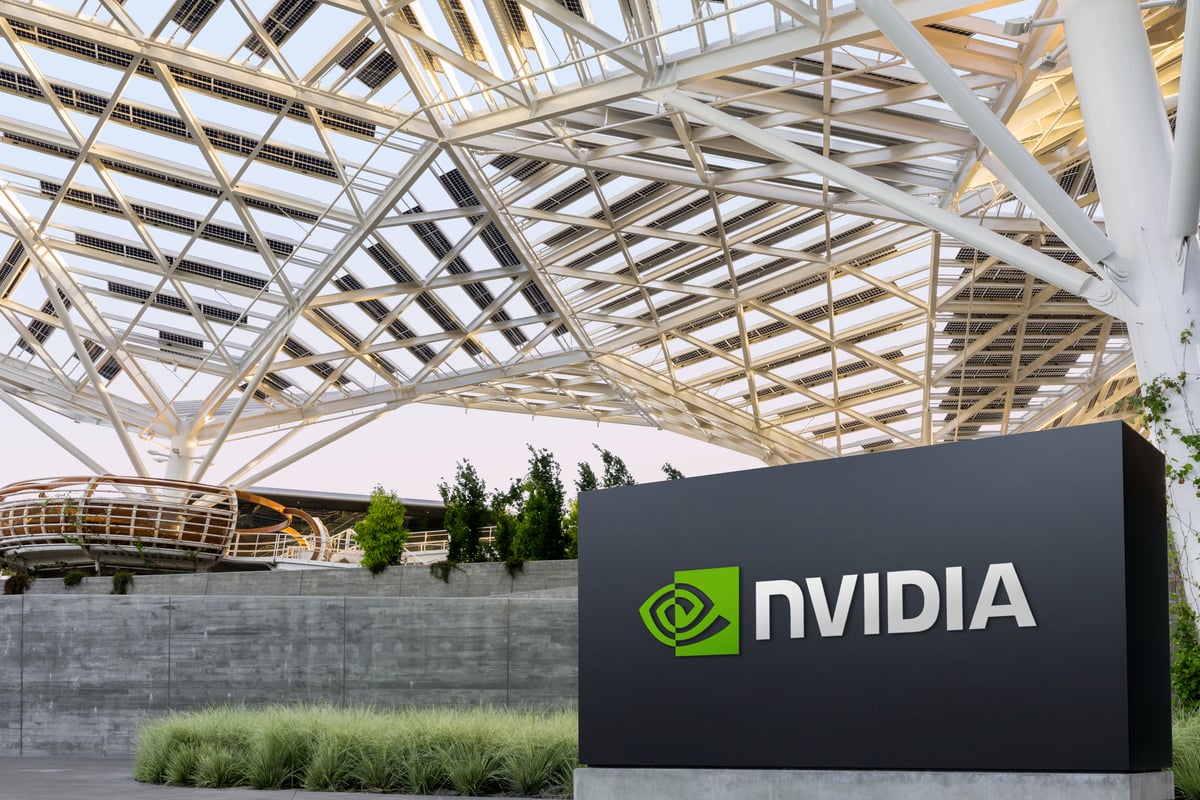
Credit for this image: Getty Images.
It’s also essential to recognize the pivotal role of Nvidia’s CUDA software platform. This versatile development environment empowers programmers to fully harness the capabilities of Nvidia GPUs, fostering deep customer loyalty and locking in long-term adherence to the company’s ecosystem of products and services.
Nvidia could face hurdles in satisfying inflated investor anticipations
Despite these favorable drivers that might propel Nvidia’s stock higher on February 25, history suggests we could witness yet another instance of the “buy the rumor, sell the news” phenomenon. This pattern has repeatedly played out after several of Nvidia’s earnings releases in recent years, as the company spearheads the AI revolution.
A primary hurdle for Nvidia lies in validating its elevated valuation within an already expensive broader market environment. Certainly, the firm’s near-monopolistic position in supplying GPUs for AI data centers warrants a valuation premium. That said, sustaining its current lofty multiples may prove exceedingly difficult.
Historical precedents reveal that when pioneering companies in revolutionary technologies exhibit price-to-sales (P/S) ratios exceeding 30, it often signals an emerging bubble. Nvidia’s P/S ratio fleetingly surpassed 30 in early November and reached even higher peaks in prior periods. Although explosive revenue growth has gradually compressed this metric, a single quarter of beating estimates and upward guidance revisions is unlikely to fully quench the thirst of investors demanding even more.
Furthermore, Nvidia’s outlook for fiscal 2027 carries risks of underwhelming shareholders. While the company has a proven ability to exceed analyst consensus in its forward guidance, two key dynamics could temper expectations for sales expansion in the coming year.
First, internal rivalries from major clients are intensifying. While much attention fixates on external challengers like Advanced Micro Devices or Broadcom’s bespoke AI silicon, the most pressing danger to Nvidia’s profitability arguably emanates from its largest revenue contributors.
Several constituents of the so-called Magnificent Seven have invested heavily in Nvidia GPUs to power their AI data centers. Intriguingly, many of these same giants are now engineering their own in-house GPUs or AI accelerators. Although these proprietary solutions fall short of Nvidia’s computational superiority, they offer substantial cost savings and immediate availability, free from the backlogs plaguing Hopper, Blackwell, and Blackwell Ultra supplies. This shift raises the specter of Nvidia ceding valuable data center shelf space to customer-developed alternatives.
The second potential dampener on fiscal 2027 prospects is the easing of GPU supply constraints. As previously highlighted, Taiwan Semiconductor is ramping up CoWoS production at an extraordinary rate to serve Nvidia and its peers. With manufacturing capacity scaling up, the acute imbalance between demand and supply is set to narrow significantly. As scarcity diminishes, Nvidia’s ability to maintain premium pricing—and its corresponding high GAAP gross margins—may correspondingly erode.
In essence, even if Nvidia delivers a flawless quarter, it stands little chance of justifying the near-vertical trajectory its stock has traced over the preceding three years amid such heightened scrutiny and expectations.