Morgan Stanley: AI Reshapes Careers, Demands Training for Future Roles
Prominent technology leaders and investors in the stock market are converging on a shared prediction: artificial intelligence is set to eradicate millions of white-collar positions permanently and make conventional jobs a thing of the past.
Shares in software and service companies have suffered significant declines, with valuation multiples for software dropping by approximately 33% since the latter part of 2025. This pullback stems from investor concerns that AI could automate enormous portions of intellectual labor. Earlier in the year, Elon Musk forecasted that advancements in AI combined with humanoid robotics would render work entirely optional over the next decade or two, leading to an economy of abundance where currency loses its significance. Musk’s perspective aligns with a rising tide of technology leaders issuing dire alerts about the potential redundancy of human workers. For instance, OpenAI’s CEO Sam Altman has warned that superintelligent systems might soon surpass even the most elite corporate leaders in capability. Similarly, Microsoft’s AI executive Mustafa Suleyman and Anthropic’s CEO Dario Amodei have estimated that comprehensive automation of white-collar tasks could materialize within one to five years. While economists question the immediacy of these timelines, they suggest that such dramatic predictions might serve partly to support sky-high valuations in the tech sector rather than reflecting an inevitable economic upheaval.
In contrast, a comprehensive research report spanning multiple asset classes from Morgan Stanley delivers a sobering yet reassuring perspective for worried workers and volatile markets: the majority of professionals will not face long-term joblessness; instead, they will transition into novel positions, a substantial number of which have yet to be conceived.
Tackling the prevalent fear that AI will displace millions of jobs and correspondingly inflate unemployment rates, a extensive group of Morgan Stanley researchers drew upon historical precedents. Throughout the last 150 years, transformative technologies—including the advent of electricity, the invention of the tractor, the rise of computers, and the expansion of the internet—have profoundly reshaped the workforce. Yet, these innovations did not result in a net loss of employment opportunities.
Consider the widespread adoption of spreadsheets during the 1980s, which streamlined laborious financial calculations and diminished the demand for specific clerical roles in bookkeeping. At the same time, this tool liberated analysts to tackle more intricate analyses and spawned fresh career paths within finance. Morgan Stanley posits that AI will follow a comparable trajectory, primarily by transforming the nature of positions, professions, and requisite competencies.
The report emphasizes that although certain functions might be fully automated, others will benefit from AI enhancements, and completely new opportunities will emerge. In essence, rather than precipitating the demise of white-collar employment, the investment bank anticipates a natural progression in the business environment.
The Emerging Professions?
What form will these forthcoming roles take? Morgan Stanley delineates a variety of nascent occupations poised to integrate into corporate structures. With AI ascending as a cornerstone of organizational strategy, businesses are likely to appoint high-level Chief AI Officers tasked with steering AI integration throughout various divisions. Additionally, there will be a substantial expansion in positions centered on AI governance, encompassing data regulation, policy management, and cybersecurity, especially within regulated fields such as healthcare.
Within the technology industry, hybrid positions like the product manager-engineer amalgamation may proliferate. Bolstered by intuitive coding interfaces that respond to natural language, product managers will increasingly participate in informal coding practices—known as vibe coding—where they prototype and refine ideas independently prior to passing them to engineers for final implementation.
Across diverse sectors, ultra-specialized jobs are anticipated. In consumer-facing industries, professionals such as AI personalization strategists and AI supply chain analysts will merge expertise in data analytics with enhancements to customer interactions. The industrial sector might witness the development of predictive maintenance engineers and smart grid specialists, whereas healthcare could require computational geneticists alongside experts in supervising AI-driven diagnostics.
Regarding financial markets, Morgan Stanley contends that the current apprehension surrounding AI-induced disruptions seems overhasty and potentially unfounded. The bank observes that sectors like services and cyclicals—which have underperformed markedly amid disruption anxieties—constitute merely about 13% of the S&P 500’s total market capitalization.
Wall Street economists have echoed similar sentiments, noting that market sentiment appears to be fueling unnecessary alarm unsupported by underlying economic indicators—a phenomenon possibly intensified by the growing participation of individual investors. Apollo Global Management’s Chief Economist Torsten Slok recently highlighted that the broader market framework is susceptible to significant fluctuations, citing heightened intraday volatility exceeding 10% for S&P 500 components alongside surging options trading indicative of retail-driven speculation and leveraged positions. Such dynamics render the market more susceptible to sudden, dramatic shifts.
Could This Era Prove Unique?
Morgan Stanley’s analysis provides much-needed optimism, yet it might be crafting an overly consoling narrative that overlooks the distinct technological and economic context of 2026. Historical patterns show that prior automation cycles generated job creation equivalent to losses incurred; however, AI could introduce a fundamentally distinct paradigm by encroaching on cognitive, inventive, and strategic functions previously deemed automation-resistant.
Coinciding with the Morgan Stanley publication, a paper by Nobel laureates Daron Acemoglu and Simon Johnson, alongside influential economist David Autor—renowned for his studies on the China Shock—asserted that this juncture might truly diverge from precedents. Titled Building pro-worker artificial intelligence and issued by The Hamilton Project, the document cautions that pure automation technologies counteract worker collaboration by commoditizing human knowledge, thereby diminishing its worth and risking its irrelevance. Broad implementation of such systems could render specific reservoirs of human specialization outdated.
The Morgan Stanley viewpoint embodies historical confidence, but precedents involving labor-amplifying tools may not seamlessly translate to an era defined by cognition-replacing systems. Speculative analyses suggest AI might yield productivity surges that further disentangle corporate earnings from workforce size, surpassing even the divergences observed during the computing revolution. Should companies expand production via predominantly automated operations, incentives to recruit at previous scales would wane.
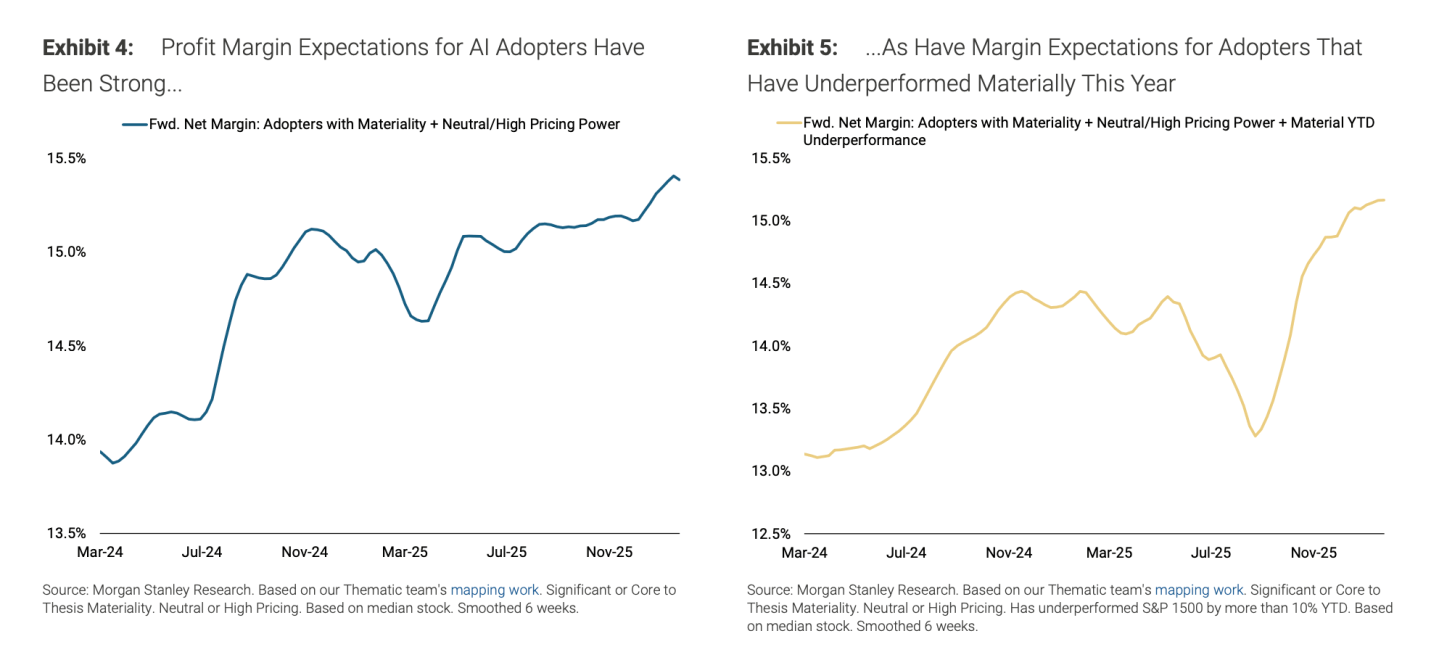
Morgan Stanley references data illustrating that U.S. corporations are already harvesting concrete gains from AI integration. By the final quarter of 2025, 30% of self-identified AI adopters documented measurable improvements in finances or efficiency, a marked rise from 16% the previous year. Consequently, projections for future profit margins are gaining momentum among firms adeptly leveraging AI. The trajectory of these margins—alongside job generation stemming from such implementations—will ultimately validate or refute Morgan Stanley’s outlook.
To develop this article, Fortune’s team employed generative AI for research assistance, with editorial oversight ensuring factual precision prior to release.