D-Wave CEO Dismisses Short Sellers After $550M Revolutionary Quantum Buy
There exist four primary publicly traded companies operating in the quantum computing sector, and they share a notable commonality: Over the past 14 months, each has faced scrutiny from activist investors engaging in short-selling strategies against their stocks.
This development is not entirely unexpected. Each of these enterprises—namely D-Wave Quantum, IonQ, Rigetti Computing, and Quantum Computing Inc.—boasts market capitalizations reaching into the billions, figures that starkly contrast with the relatively modest income streams produced by their ongoing operational activities.
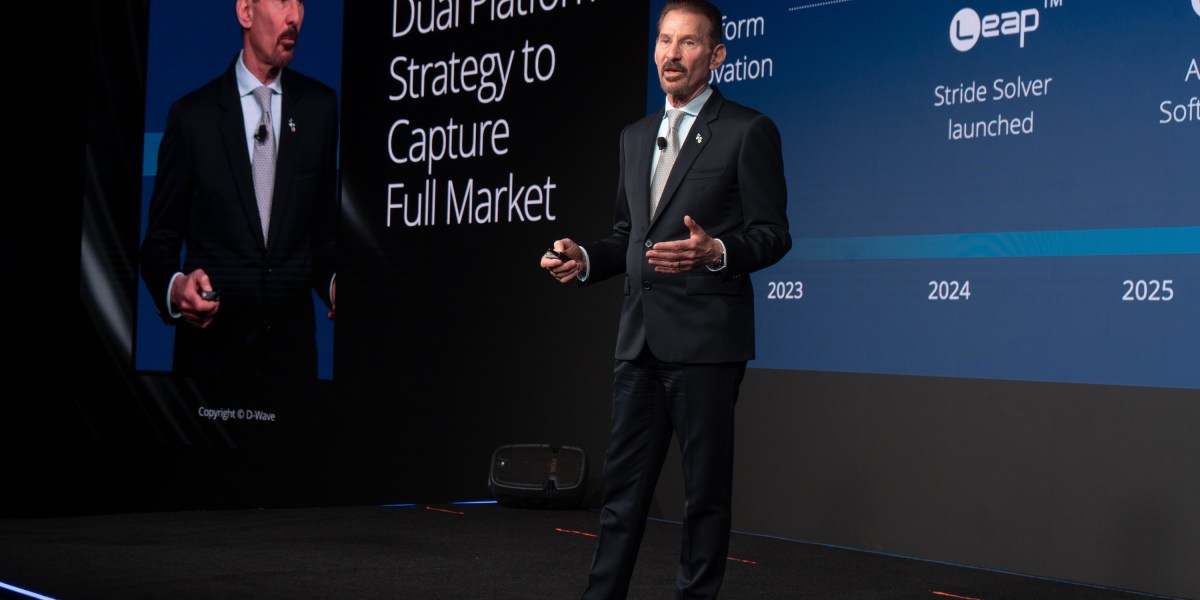
Alan Baratz, the chief executive officer of the 27-year-old firm headquartered in Palo Alto, California, views these short-selling assaults as an inherent occupational risk. His organization became the focus of attention from Kerrisdale Capital back in April of the previous year, when the firm contended that there existed no substantial evidence demonstrating that D-Wave’s quantum systems could outperform standard classical computers in tackling intricate computational challenges.
Almost a full year following Kerrisdale’s pointed critique, D-Wave’s share price has experienced a remarkable tripling in value. A resolute Baratz is now highlighting key metrics that directly refute the allegations leveled by Kerrisdale: a threefold surge in revenue figures, an expansion to over 100 clients making payments for services (including a fresh licensing agreement valued at $10 million), and a substantial $550 million acquisition poised to address one of the most persistent hurdles in the quantum computing domain.
Fighting off ‘untrue statements and characterizations’
Campaigns initiated by short sellers are fundamentally driven by individuals betting against the stock with the aim of generating profits. As such, Baratz recently explained to Fortune, one must approach their claims with considerable skepticism. He emphasized, “There were numerous inaccuracies, false assertions, and misleading portrayals contained within the Kerrisdale report, which led us to simply disregard it entirely.”
The core of Kerrisdale’s offensive rested on a particularly striking claim: “A diverse array of D-Wave customers we spoke with across critical industries such as logistics, manufacturing, and pharmaceuticals indicated they derived absolutely no advantages from the technology,” the report stated at the time. The company’s stock experienced brief volatility in the immediate aftermath of the publication, only to climb decisively thereafter, advancing from roughly $6 per share to $15 per share by the close of May 2025.
Baratz acknowledges that these types of reports may occasionally contain elements of factual basis, yet they are frequently marred by distortions and exaggerations. For example, he pointed out regarding Kerrisdale’s document, “It cited an individual purportedly employed by one of our customers, but investigations revealed they were not associated with any of our clients at all—that’s the caliber of misinformation prevalent in such analyses.”
Since the release of that report, D-Wave’s stock has not only recovered but has continued its upward trajectory, mirroring strengthening fundamentals in its core operations. In its latest disclosure, the company announced $22 million in revenues over the most recent nine-month span, representing a tripling from the $6.5 million recorded in the comparable prior-year period.
From a short seller’s perspective, a significant issue persists: D-Wave’s current market capitalization stands at $7.4 billion, substantially exceeding what its operational value might conventionally justify. Approximately 16% of its outstanding shares are presently held in short positions, a proportion notably higher than typical market averages.

Baratz concedes that speculative fervor significantly inflates the valuations of quantum computing equities. He elaborated, “Estimates for the total addressable market in quantum technologies vary widely depending on the source, ranging from $200 billion up to as much as $1 trillion. Those firms that successfully pioneer practical implementations capable of tapping into this potential will command extraordinary valuations, and investors are placing their wagers accordingly on such frontrunners.”
From R&D to revenue
A persistent challenge confronting the quantum computing industry involves transitioning from intensive research and development phases into phases characterized by scalable, commercially feasible applications deployable in practical, real-world environments.
Fabricating this technology presents formidable difficulties. In conventional classical computer chips, the fundamental processing units known as gates or bits operate on straightforward principles akin to light switches: they exist in either an on or off state, conveying binary signals of 1 or 0 at any particular instant. Quantum computers, however, leverage subatomic particles that emit data amid states of quantum uncertainty, allowing their gates—or qubits—to represent 1 or 0, or simultaneously both, or possibly neither, within the same timeframe.
This capability of qubits to transmit information through superposition—where multiple states coexist and convey data concurrently—positions quantum systems as potentially far superior in computational power compared to classical chips. Nevertheless, the abundance of additional informational states introduces a heightened susceptibility to errors, rendering the task of error correction in quantum qubits—effectively isolating the true signal amid the surrounding noise—a profoundly complex endeavor.
D-Wave candidly addresses these realities in its most recent annual filing, stating, “Constructing functional quantum computers demands breakthroughs across both scientific understanding and engineering prowess, areas where we may ultimately fall short in delivering the requisite advancements.” It further cautions that subsequent generations of its hardware “could face delays in development or might never materialize … likewise, our outlined technical roadmap carries risks of postponement or complete non-achievement.”
To mitigate these uncertainties, D-Wave took decisive action last month by acquiring Quantum Circuits (QC) for $550 million. This entity specializes in superconducting quantum gate computers and originated as a spinout from Yale University. Baratz is confident that QC’s founder, Robert Schoelkopf, has pioneered a qubit fabrication technique that achieves higher operational speeds while maintaining reduced error rates.
Producing a single qubit capable of logical operations—meaning one that operates without errors or interference—necessitates employing a considerably larger quantity of physical qubits dedicated solely to error detection and mitigation. Certain competitors in the field still require upwards of 1,000 physical qubits to support and stabilize just one reliable logical qubit.
Baratz asserts that through integration with the newly acquired technology, D-Wave can dramatically improve this efficiency, targeting a range of only 25 to 100 physical qubits per logical qubit. He described QC’s chip architecture enthusiastically: “These chips enable error correction using a minimal complement of physical qubits. They represent a truly revolutionary advancement.”
A $10 million all-you-can-eat buffet
The incoming innovations from QC are set to enhance D-Wave’s foundational business model, which revolves around a specialized quantum technique termed annealing. In this approach, quantum computing optimizes solutions amid vast arrays of variables by identifying the configuration corresponding to the minimal energy state within the quantum framework. (Indeed, the underlying mechanics are intricate and multifaceted.)
This annealing-based service is demonstrating promising commercial momentum. Recently, D-Wave secured a $10 million, two-year licensing agreement with an undisclosed Fortune 100 corporation, granting the client unlimited access to D-Wave’s full suite of offerings—essentially an all-inclusive buffet of quantum computing resources.
Furthermore, the company reports a customer base exceeding 100 entities generating revenue, encompassing prominent names such as Ford, BASF, Shionogi from Japan, and Pattison Food Group. A key differentiator lies in the composition of its clientele: fewer than 10% of D-Wave’s customers consist of government research contracts, according to Baratz.
He underscored this distinction, noting, “This sets us distinctly apart from peers. Examining the revenue breakdowns of virtually all other standalone quantum computing ventures reveals that around 90% derives from government engagements. Essentially, they leverage public grants to subsidize their research efforts and reclassify those funds as revenue—a prevalent practice in the industry.”
In summary, D-Wave’s strategic maneuvers, including the landmark acquisition and burgeoning commercial contracts, position the company to navigate short-seller pressures while advancing toward practical quantum supremacy. The integration of Quantum Circuits’ error-resistant qubit technology promises to bridge critical gaps between theoretical potential and deployable reality, potentially reshaping the competitive dynamics of the quantum computing landscape. As investor enthusiasm persists amid a trillion-dollar market opportunity, Baratz’s leadership emphasizes tangible progress over speculative narratives, fostering sustained growth in both revenue and technological prowess.