Analyst: Skip College Debt, Train as Electrician Amid AI Job Risks
With artificial intelligence posing a significant threat to white-collar employment opportunities and living expenses surging to unprecedented levels, alarming predictions about the erosion of professional jobs are gaining widespread attention—including analyses from Citrini Research and Matt Shumer. A leading international strategist delivers a sobering message to the younger generation: bypass traditional university education and pursue vocational training instead.
Albert Edwards, a seasoned macroeconomic expert renowned for his unconventional perspectives and self-proclaimed persistently pessimistic stance on markets, is raising urgent concerns about an economic system that increasingly disadvantages the youth. Referencing the highly popular cautionary report from Citrini Research, Edwards noted in his weekly global strategy update that he has been advancing these very points from within a major international investment bank.
When considering the evident advantages of accelerating productivity driven by AI for investors, coupled with declining labor costs per unit, subdued inflation, and reduced interest rates, Edwards contends that the unmistakable reality is that AI is already inflicting substantial harm on overall employment opportunities, particularly for those freshly emerging from university programs.
Edwards candidly stated, “I can honestly say that if I was 18 now, there is no way I would go to university only to leave with huge debts and poor job prospects.” He added, “Instead, I would become an electrician or similar trade.” Edwards himself experimented with such work at age 22, when he rewired his first home in 1983—a project he deems successful, despite an unfortunate incident where he lost the tip of his left thumb due to contact with a live wire. “To my knowledge, that house hasn’t burnt down yet,” he remarked.
Edwards, who has previously engaged in detailed discussions with Fortune about his evolution as an analyst toward more radical viewpoints, emphasizes that his opinions do not reflect the official position of Societe Generale. He has consistently critiqued modern capitalism, as demonstrated in his 2023 examination of record-high corporate profit margins, where he suggested “we may be looking at the end of capitalism.” Now, three years on, he foresees the demise of the human element within capitalism. “The AI macro doomsday scenario is not for 2028,” he asserted. “It’s here right now!”
The Brick Wall
Edwards’ cautionary outlook arises from his conviction that waiting until 2028 for an AI-induced catastrophe would be too late, given the tangible damage already evident in economic data. Layoffs that began in the technology sector have now permeated diverse fields such as insurance, asset management, and supply chain operations. Central to his assessment, however, is the observation that everyday consumers are operating on depleted resources.
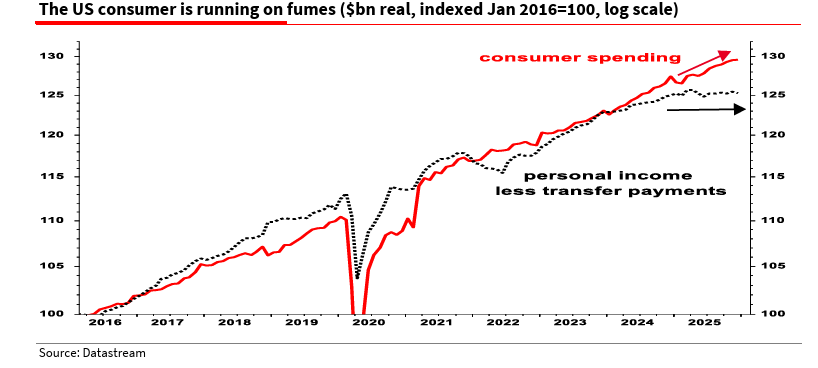
Although overall consumer expenditure seems to be expanding at a robust pace of almost 3%, Edwards points out that this expansion is illusory, lacking any backing from genuine personal disposable income, which has stagnated over the past six months. Rather, households are sustaining themselves by depleting their accumulated savings.
The personal savings rate has plummeted to a strikingly minimal 3.6%—a figure unseen since the height of optimism during the 2006 housing market frenzy. Edwards warns that the economy is hurtling toward a consumer squeeze fueled by AI, where workforce reductions lead to diminished spending, which in turn sparks additional redundancies as businesses prioritize preserving elevated profit margins.
For context, the Citrini Research publication cautioned about a potential “deflationary spiral” and “ghost GDP,” triggered by AI’s rapid displacement of white-collar roles, plunging that segment into a severe recession. In the U.S., where services dominate and white-collar positions represent about 50% of jobs and 75% of discretionary purchases, the analysis posits that productivity boosts from AI will primarily benefit capital owners. These gains would be channeled into further automation rather than worker compensation, mirroring the income stagnation Edwards identifies as already in progress.
Edwards further explained that the sharp drop in the savings rate reflects a immediate response to “real incomes hitting a brick wall.” In the near term, he anticipates the savings ratio will either stabilize—resulting in flat consumption growth—or increase as a protective measure, thereby contracting total spending across the economy.
Marx for the Digital Age?
Although research from the sell-side has been relatively measured in addressing the Citrini thesis—which some estimate contributed to a $300 billion market downturn in 2026—Evercore ISI’s Krishna Guha described it as “a high tech version of Marx’s thesis that capitalism would ultimately destroy itself by immiserating the petit bourgeois and working class until it had no consumers left, no additional profits to be earned on existing products produced, and no reason to grow.” Commentators like Marginal Revolution’s Tyler Cowen, an economist at George Mason University, and Ritholtz Wealth Management’s Josh Brown have contended that it is unlikely for AI to mark the first instance in centuries of capitalist history where technological progress fails to generate new employment avenues.
In prior conversations with Fortune, Edwards revealed that his analyses are deeply influenced by the fact that this is the inaugural American generation anticipating a lower standard of living than their parents, fostering a profound sense of disillusionment. He maintains that corporate overreach and greed have “laid the seeds for their own destruction.” Young people, excluded from meaningful participation in contemporary capitalism, find little motivation to engage with the system. This dynamic has fueled significant “intergenerational strife,” exacerbated by barriers to wealth accumulation and a housing market that feels utterly inaccessible—underscored by the average first-time homebuyer age now reaching 40.
Fortune recently spoke with Seth Lavine, an experienced venture capitalist, and Elizabeth MacBride, a seasoned reporter, co-authors of Capital Evolution: The New American Economy, a work that probes the uncertainties surrounding the economy’s trajectory. MacBride observed that neoliberal capitalism emerged in a context that overlooked behavioral psychology, emphasizing purely economic incentives while neglecting humans’ emotional drivers. With neoliberalism’s credibility eroded post-2008 financial crisis, we find ourselves in a “messy middle.” Insights from their book’s interviews reveal that prominent executives like BlackRock CEO Larry Fink and JPMorgan’s Jamie Dimon, alongside ordinary middle-class citizens, harbor similar anxieties about the path ahead.
“Belief in the future is breaking down,” MacBride emphasized, citing troubling signs like declining life expectancy and a suicide epidemic among white men as clear indicators of systemic breakdown. Economic mobility has drastically diminished: half a century ago, someone born into the lowest wealth quartile had a 25% probability of ascending to the top; today, that figure has dwindled to a mere 5%. “People do not feel like following the rules of the system is going to get them anywhere,” she concluded.
“This is probably the first generation [that] won’t be expected to outrun their parents,” Lavine supplemented. “So I mean, just by basic measures, we’re failing to provide for sort of economic mobility.”
The resonance of the AI doomsday narrative may stem from fears that this innovation, rather than revitalizing the middle class in the 21st century, might deepen divisions by eradicating fragile white-collar positions that once offered tenuous middle-class footholds. Is embracing manual trades with a toolbox a more secure path than gambling on degrees that lead to debt and instability? As Edwards once reflected to Fortune on capitalism’s flaws, “You reap what you sow.”