
AI Capex Surge Risks Cash Flow Negativity for Big Tech Hyperscalers
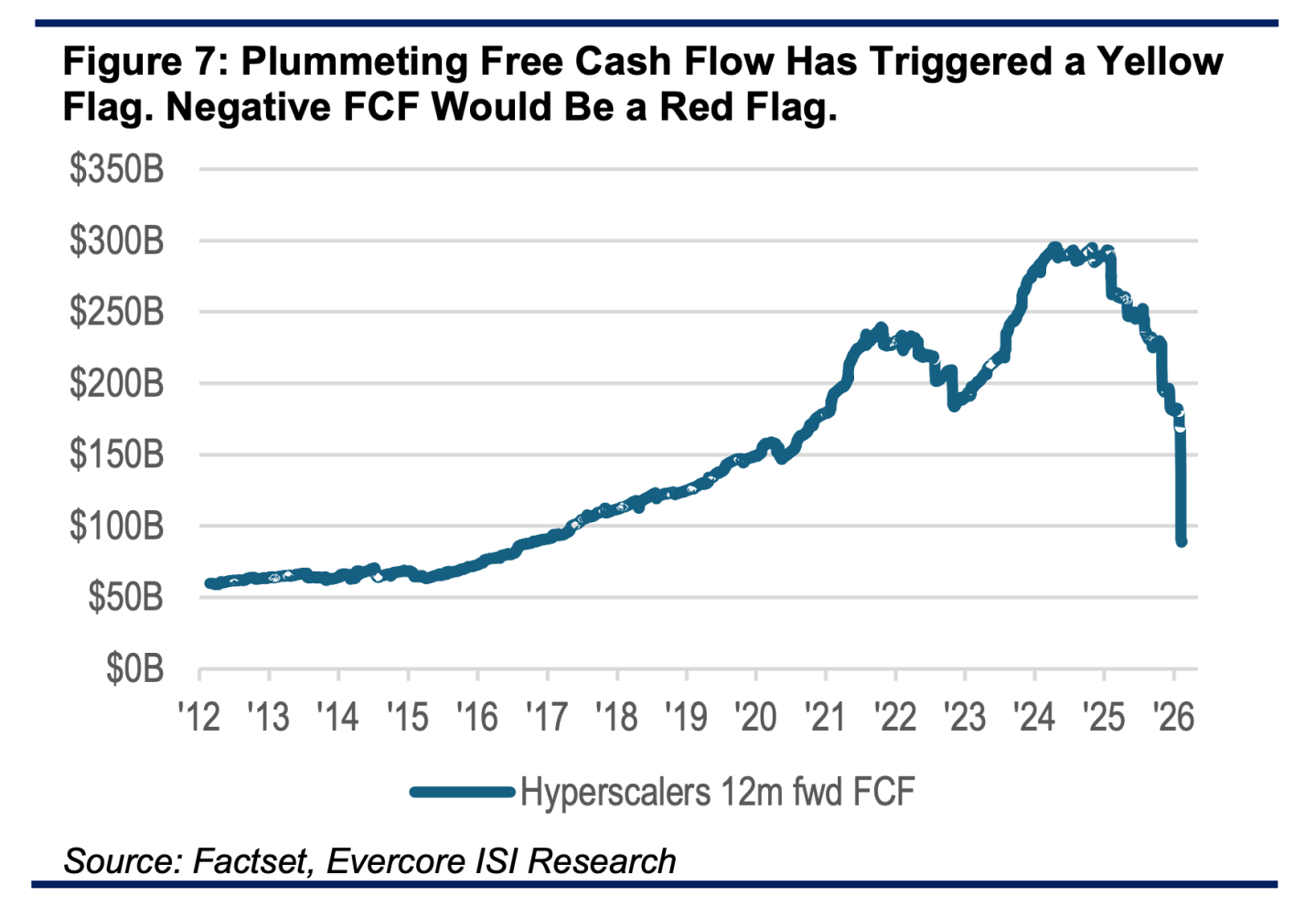
Major technology firms are pouring enormous sums into artificial intelligence infrastructure, with capital expenditures reaching levels that could push some hyperscalers into negative cash flow territory, signaling a potential warning sign for their stock valuations, as noted by analysts at Evercore ISI.
Investor concerns regarding AI’s influence on equity markets have triggered substantial fluctuations in the S&P 500 index so far this year. Market participants have been swinging between aggressively buying technology shares following upbeat quarterly earnings releases and rapidly offloading them amid fears that AI advancements might undermine the core operations of these businesses.
Projections indicate that Meta will allocate approximately $55 billion toward AI-related capital expenditures in the current year. Alphabet has announced plans to double its spending to $180 billion, while Amazon anticipates a 50% ramp-up, targeting $200 billion. These figures come from insights provided by Evercore’s Julian Emanuel and his research team. Earlier estimates from Wells Fargo suggested a 24% rise in sector-wide AI capex for 2026, potentially totaling around $660 billion, as reported by the Financial Times.
The escalating capital outlays are compelling these corporations to divert a larger portion of their available cash flows toward future investments, often necessitating additional debt issuance to sustain growth initiatives. While this debt-fueled expansion has introduced some unease among investors, there are still no widespread indications of systemic risks tied to AI development. Overall, the leverage profiles of these companies continue to appear robust and manageable.
That said, analysts point out that debt balances have been climbing, with Alphabet’s recent issuance of over $30 billion serving as a prime example from just last week. Consequently, when viewed collectively, the hyperscalers now carry more debt on their balance sheets than liquid cash reserves. Even so, these debt levels remain below the median observed across S&P 500 constituents, providing some reassurance.
The more pressing concern revolves around free cash flow generation, according to Emanuel and his colleagues. Current spending patterns reveal that leading AI-focused hyperscalers are expending such a significant share of their free cash flow on AI infrastructure—often described metaphorically as building the ‘railroad tracks’ for generative AI—that this metric is on the verge of turning negative.
They highlighted in their client note that a preliminary ‘yellow flag’ has already been activated. Although aggregate free cash flow production stays positive for the time being, the relentless outlays for generative AI foundational elements are emerging as a critical focal point. The hyperscalers’ trailing 12-month forward free cash flow has now sunk below the lows recorded during the 2022 market cycle, marking a notable deterioration.
Amazon’s disclosed $200 billion capex commitment for 2026 exceeded market expectations and positions the company for what is likely to be its first negative free cash flow year in recent memory. Should free cash flow flip to negative across the hyperscaler group as a whole, it would constitute a glaring ‘red flag’ moment, demanding heightened investor scrutiny.
The analysts further cautioned that an accumulation of additional ‘yellow’ and ‘red’ flags emerging alongside continued AI-driven market advances could suggest that investor sentiment, rather than fundamentals, is primarily fueling returns—a classic precursor to bubble formation.
Despite these cautionary signals, Evercore maintains its year-end forecast for the S&P 500, projecting it to reach 7,750 points, reflecting a degree of optimism amid the uncertainties.
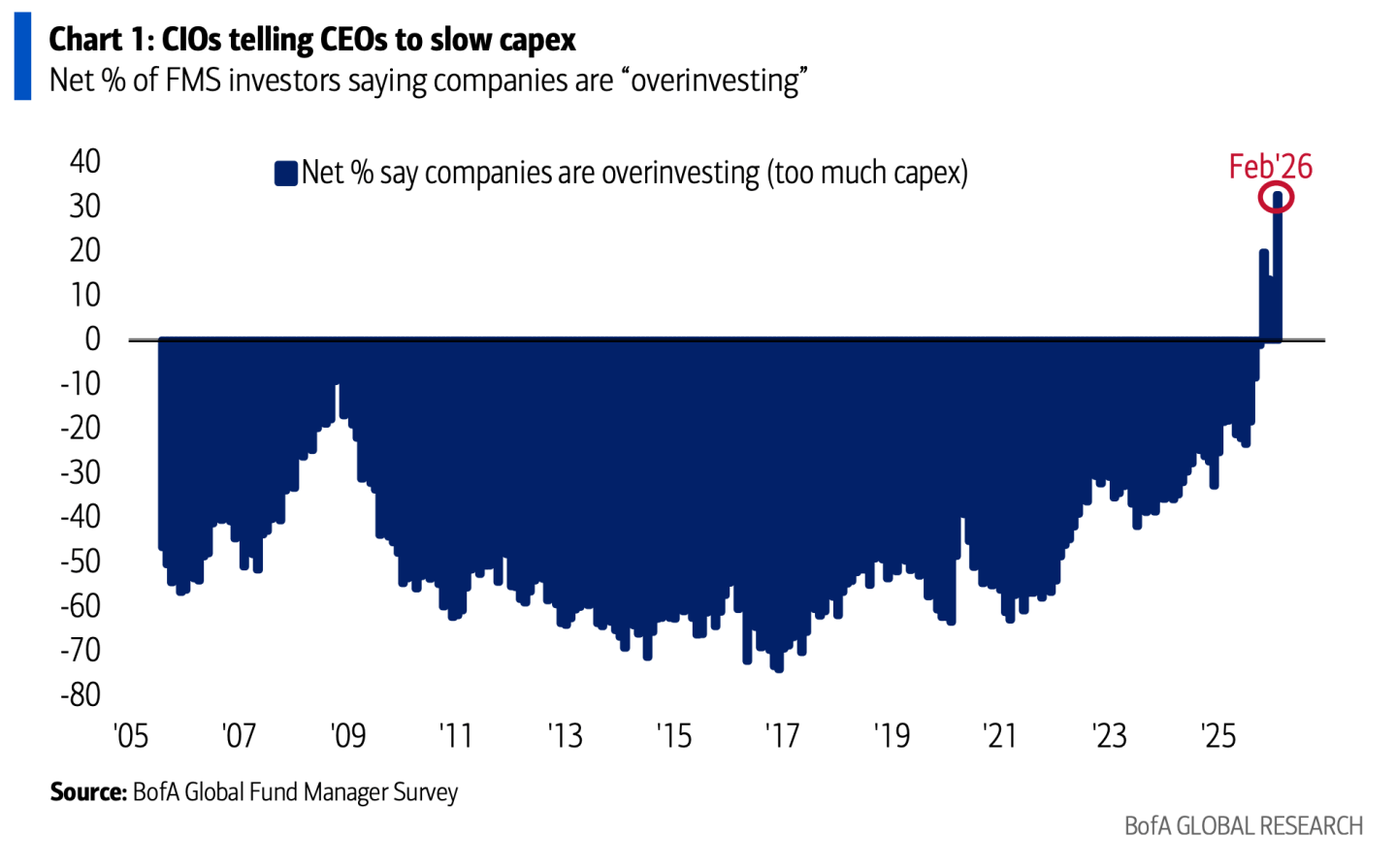
Other prominent financial institutions have echoed similar apprehensions about the trajectory of AI capital expenditures. Bank of America’s monthly poll of investment fund managers revealed a notable uptick in chief investment officers advising their CEOs to prioritize bolstering cash positions on balance sheets over aggressive capex increases. This sentiment shifted from 26% in the prior period to 35% in February. As Michael Hartnett and his team observed in their research note, the current capex environment feels excessively heated.
Meanwhile, at RBC Capital Markets, Lori Calvasina and her colleagues have been closely monitoring the potential for AI-related overspending or overhype, particularly given that valuations and capex commitments for the largest market capitalization technology names are approaching historical peaks. Up until recently, worries that the AI investment theme might be overstretched appeared to encourage a constructive rotation within U.S. equities and prudent risk controls. However, February has seen this evolve into more decisive de-risking behaviors across the board.
Calvasina advised her clients that her firm continues to favor the perspective that the AI trade has become somewhat extended rather than indicative of an outright bubble, suggesting a measured approach rather than panic.
To provide context on the broader market environment this morning, here is a concise overview of key global indices and assets:
- S&P 500 futures declined by 0.39% in early trading, following a flat close at 6,836.17 in the previous session.
- STOXX Europe 600 showed minimal movement, trading essentially flat during initial European hours.
- U.K.’s FTSE 100 registered a modest gain of 0.14% at the open.
- Japan’s Nikkei 225 slipped by 0.42%.
- China’s CSI 300 remained closed in observance of Lunar New Year celebrations.
- South Korea’s KOSPI was also shuttered for the Lunar New Year holiday.
- India’s NIFTY 50 edged higher by 0.17%.
- Bitcoin eased back to around $67.8K.
This snapshot underscores the mixed global sentiment, with technology-driven concerns contributing to selective pressures amid ongoing AI investment debates. The combination of surging capex demands and shifting cash flow dynamics is prompting analysts to urge vigilance, even as the long-term transformative potential of AI remains a powerful draw for investors willing to navigate the risks.
Evercore’s detailed analysis draws attention to how these hyperscalers—predominantly Amazon, Alphabet, Meta, and peers—are reallocating resources at an unprecedented scale to support AI model training, data center expansions, and related hardware procurements like GPUs. This infrastructure buildout is essential for maintaining competitive edges in the generative AI race, yet it strains financial engineering capacities in ways not seen since prior tech investment booms.
Historical parallels to past cycles, such as the dot-com era or the 2022 downturn, offer sobering reminders that exuberant capex without commensurate revenue acceleration can lead to painful corrections. Nonetheless, the unique nature of today’s AI paradigm—where foundational investments could yield network effects and monopolistic advantages—differentiates it somewhat, according to optimists within the analyst community.
Fund managers surveyed by Bank of America are increasingly prioritizing liquidity buffers, reflecting a pragmatic response to elevated valuations and capex intensity. This shift could temper near-term multiple expansions for big tech names, potentially fostering broader market rotations toward value or cyclical sectors if AI hype moderates.
RBC’s balanced outlook encapsulates the prevailing tension: acknowledgment of overstretched positioning without conceding to bubble narratives. Investors are thus advised to monitor free cash flow trajectories closely, particularly as 2026 guidance solidifies, with Amazon’s trajectory serving as a bellwether for the group.